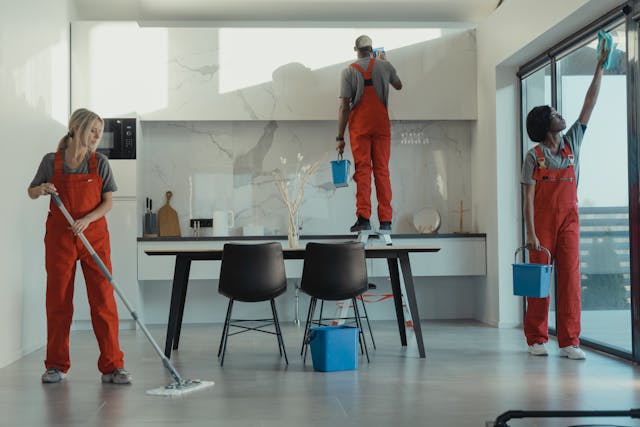
Cleaning has the lowest startup cost of any service trade. For under $1,500, you can buy supplies, print flyers, build a one-page website, and book your first recurring client. That low barrier is exactly why most cleaning businesses stay stuck as under-earning solo operations — the market is flooded with hobbyists, side-hustlers, and underpriced competitors racing each other to $25/hour.
This playbook is for the operator building a real cleaning business. Whether you want to stay a solo $75K-$100K earner with a tight route of loyal recurring clients, or scale to a $500K+ multi-crew operation, the fundamentals are the same: flat-rate pricing by home size, recurring contracts with autopay, disciplined hiring, and tight route density. Miss any of those, and you’ll be busy without being profitable.
Chapter 1: The State of the Cleaning Industry in 2026
Residential cleaning demand is strong in 2026 and continues to grow. Two-income households, aging homeowners, and the post-2020 normalization of household help have pushed the percentage of US homes using a cleaner to an all-time high. According to IBISWorld’s House Cleaning Services industry report, the US residential cleaning market generates over $10 billion in annual revenue and has grown steadily over the past five years. The industry is fragmented — most cleaning companies are under 10 employees, which means a well-run operator can take market share quickly.
Here are the 2026 benchmarks:
- Hourly rates per cleaner: $25-$75 depending on market, with $30-$60 being most common (the BLS Occupational Outlook Handbook reports a median wage of $15.49/hour for maids and housekeeping cleaners, but that includes low-paying commercial and hotel roles — independent residential cleaning commands significantly more). Flat-rate pricing (by square footage) is standard for established companies.
- Per-visit pricing: $100-$170 for homes under 3,000 sq ft, $200-$400 for larger homes, $250-$500+ for deep cleans and move-out work.
- Square-footage pricing: $0.08-$0.12/sq ft for recurring cleans; $0.15-$0.25/sq ft for one-time deep cleans and move-outs.
- Gross margin: 50-70% for solo operators, 35-55% once you have W-2 employees.
- Net profit margin: 15-30% for well-run companies. 25-35% for top operators with tight routes and strong recurring revenue.
- Solo operator income: $55K-$95K typical, up to $120K+ for tight-route operators with premium pricing.
- Per-cleaner productivity: $55-$95/hour in billable revenue (for a solo or cleaner-owner combo); $45-$70/hour for employee crews.
The single biggest predictor of profitability isn’t how fast you clean. It’s your mix of recurring vs. one-time work. Top cleaning operators generate 80-90% of their revenue from recurring contracts. Low-margin operators live in the one-time/move-out market because they never built a recurring base.
The Trust Gap: Why Cleaning Is a Different Kind of Business
Every field service trade requires some degree of customer trust. But cleaning occupies a unique position: your team enters the client’s home when no one is there, has access to every room, handles personal belongings, and works unsupervised for 2–3 hours. No other trade operates with this level of intimate access on a recurring basis.
This trust gap is both your biggest obstacle and your biggest moat. Crossing it requires:
- Background checks on every team member. Not optional. Run them before the first day and re-run annually. Advertise this prominently — “all team members background-checked” is a top-3 purchase driver for residential cleaning clients (per ISSA’s 2024 Residential Cleaning Consumer Survey).
- Bonded and insured — with proof. Have your certificate of insurance and bond documentation available as a PDF you can email within 60 seconds of a client asking. Put the policy limits on your website.
- Consistent teams. Clients build trust with specific people, not with a company name. Assign the same cleaner (or team) to the same homes every visit. Rotation destroys trust and increases cancellations by 20–30% (per ISSA).
- Checklists and photos. Document every visit with a checklist completion and 3–5 photos of key areas. This protects you from “you broke my vase” claims and signals to the client that you take the work seriously.
Companies that close the trust gap command 25–40% higher prices than competitors who compete on cost alone. The trust premium is real, and it compounds — trusted cleaners get referred to friends and neighbors who are also willing to pay more.
Chapter 2: Licensing, Insurance, and Setting Up Legally
Cleaning is one of the least-regulated trades, which makes it easy to start and surprisingly easy to get in trouble if you skip the basics. Most states require no specialty license — but every state requires you to register a business, and every insurer expects you to carry the right coverage before you enter a client’s home.
Your startup checklist:
- LLC formation: $50-$500, depending on the state. Non-negotiable. Mixing personal and business assets in an in-home service business is a lawsuit waiting to happen.
- EIN and business checking account: Free from the IRS. Don’t run the business from your personal account.
- Local business license: Most cities/counties require one. $50-$200/year.
- General liability insurance: $1M-$2M minimum. $500-$900/year for a solo cleaner, $1,400-$3,000 for small teams. Covers broken belongings and accidental damage.
- Janitorial bond (“cleaning bond”): $10K-$25K. Covers client losses from employee theft. Costs $100-$300/year. Essential — clients will ask if you’re bonded.
- Workers’ comp: Required the day you hire your first W-2 employee. Cleaning class codes run $3-$7 per $100 of payroll. Note: the IRS guidance on W-2 vs. 1099 classification makes it clear that most cleaning workers are W-2 employees — if you set their schedule, provide supplies, and dictate how the work is done, they are employees under the common-law test.
- Commercial auto: If you use a vehicle for business, personal auto excludes this use. $900-$2,000/year.
“Bonded and insured” is one of the most marketed phrases in cleaning for a reason — clients invite strangers into their homes, and they need to know they’re protected. Add it to your website, flyers, estimate templates, and intake calls.
Background checks are industry standard. Run one on every cleaner you hire through Checkr, GoodHire, or a similar service ($25-$60 per check). Put it in your marketing. “All team members background-checked” closes deals when competitors can’t say the same.
Chapter 3: How to Price Cleaning Services for Profit
Most cleaning businesses underprice because they benchmark off Craigslist, Facebook groups, and TaskRabbit. That’s a race to the bottom. The operators who set real-money prices by home characteristics and target margin, not by what the cheapest cleaner on NextDoor charges.
Build a break-even model for a solo cleaner:
- Target owner take-home: $75,000/year
- Self-employment tax (15.3%): $11,500
- Health insurance: $7,800 ($650/month)
- Vehicle (payment, fuel, insurance, maintenance): $7,200
- Business insurance + bond: $1,200
- Supplies, equipment, software, phone: $4,800
- Marketing (ads, website, print): $3,600
- Licensing, accounting, bank fees: $1,800
- Total required revenue: $112,900
You work 48 weeks, average 30 billable hours/week (the rest is drive time, quoting, supplies runs, admin) = 1,440 billable hours. Break-even rate = $112,900 ÷ 1,440 = $78/hour. If you’re charging $45/hour, you are $33/hour underwater — that’s $47,500/year you’re not making back.
The fix: stop pricing by the hour. Price by the home. A 2,000 sq ft home on recurring bi-weekly service at $165/visit that takes 2 hours 15 minutes = $73/hour productivity. The customer doesn’t care whether you finish in 2 hours or 2.5 — they paid for the clean, not for the clock.
Flat-rate pricing by square footage is the standard — ISSA (The Worldwide Cleaning Industry Association) benchmarks and IBISWorld data both confirm that per-visit flat rates outperform hourly billing on client retention and gross margin. Build a simple matrix:
| Home Size | Bi-Weekly Visit | Deep Clean (1×) |
|---|---|---|
| Under 1,500 sq ft, 2 bed | $120–$145 | $195–$235 |
| 1,500–2,000 sq ft, 3 bed | $155–$185 | $250–$300 |
| 2,000–2,500 sq ft, 3–4 bed | $185–$225 | $300–$365 |
| 2,500–3,500 sq ft, 4–5 bed | $225–$285 | $365–$460 |
| Over 3,500 sq ft | $285+ custom | $460+ custom |
Charge 15-25% more for weekly (smaller jobs, tighter schedule) vs. monthly (bigger jobs, harder buildup). Charge 40-60% more for one-time deep cleans. Charge 70-100% more for move-out cleans.
We break down the break-even methodology and give you a downloadable calculator in Job Costing for Field Service: How to Know if a Job Actually Made You Money. Run your numbers before you accept another booking.
Chapter 4: Job Costing — Which Cleans Actually Make Money
Cleaning margins hide in aggregate revenue. A full week of 25 stops looks the same on paper, whether you made $2,800 or $4,100 — but only one of those weeks pays the bills. The difference is almost always in two places: (1) drive time between stops, and (2) homes that take longer than the quoted time.
Track three numbers per job:
- Actual minutes on-site (GPS check-in/check-out; handwritten logs lie)
- Drive minutes from the previous stop
- Supplies used (rough, by home size category)
After 60 days, sort your recurring clients by actual dollars-per-hour earned. You will find 15-25% of accounts are under-performing — usually because the home grew messier since the original quote, a pet was added, scope crept, or the original quote was too generous.
Fix the underperformers in two waves:
- Wave 1 (underpriced but efficient): Raise prices $15-$35 with 30 days’ notice. Most clients accept it. Those who don’t — let them cancel.
- Wave 2 (impossible homes): Some homes take 3.5 hours to clean and will always take 3.5 hours. Either requote at the right time or politely end the relationship.
This single exercise raises net margins 3-6 percentage points without adding a single client. It’s the highest-leverage move in cleaning operations.
Chapter 5: Winning Clients — Estimates, Walk-Throughs, and Closing
Cleaning is a trust sale. Clients aren’t comparing you to one competitor — they’re deciding whether to let a stranger have a key to their home. Your estimate and first impression determine whether they ever invite you in.
The winning intake flow:
- Phone or text intake (8-10 minutes): Home size, number of bedrooms and bathrooms, pets, desired frequency, any special areas (finished basement, playroom, office), condition (routine, messy, needs catch-up).
- Same-day written estimate: Flat rate, scope of what’s included, what’s not included, cancellation policy, payment terms, bonded/insured language, team or solo, background-check language.
- Optional walk-through: Only for homes over 3,000 sq ft or those that are unusually messy. For standard homes, skip it — the walk-through adds friction and delays the close.
- First-visit upgrade: For new recurring clients, the first visit is always priced as a deeper clean ($50-$125 premium) because you’re catching up on accumulated buildup. Disclose this up front.
Clean estimates sent within 2 hours of first contact win 60-75% more often than estimates sent the next day. Speed signals professionalism and availability. Use a template — every manual rewrite is a delay.
Offer tiered service levels where it makes sense:
| Service Level | Includes | Price |
|---|---|---|
| Standard | Kitchen, bathrooms, dusting, vacuuming, mopping, trash | $165 |
| Standard+ | + inside oven, inside fridge (quarterly), baseboards | $195 |
| Deep | + interior windows, cabinet fronts, detailed dusting | $265 |
Grab our free cleaning service estimate template and use it on every new client.
Chapter 6: Getting Paid — Autopay, Cards on File, and Zero Receivables
Cleaning businesses should have zero receivables. Every recurring client should be on autopay before the first clean, full stop. No invoicing, no reminders, no “I’ll pay you next week.”
Card-on-file autopay works because cleaning is a low-cost, high-trust, recurring service. Clients don’t want to write a check every two weeks any more than you want to collect one. Make autopay the default at signup:
- Capture the payment method during intake or before the first visit
- Charge automatically within 24 hours of each cleaning
- Send the receipt via email/text immediately after the charge
- Store a secondary payment method for fallback on declines
Card fees run 2.6-3.5% — worth it to eliminate collections entirely. For clients who insist on a check, charge a $10 “billing fee” or discount 3% for ACH. Most switch to a card within 60 days.
For one-time cleans, deep cleans, and move-outs — collect 50% deposit at booking, balance via autopay the day of service. Move-out cleans especially need full pre-payment because once you’ve cleaned an empty house, there’s no leverage left to collect.
The full payment playbook is in How to Collect Payment on the Job Site, and the quote-to-invoice workflow is detailed in How to Streamline Your Quote-to-Invoice Workflow — the principles apply identically to cleaning.
Chapter 7: Route Density and Scheduling — The Hidden Margin Lever
Cleaning is the most route-sensitive of all trades. Every mile between stops is a double cost: labor time, fuel plus lost billable productivity. A cleaner driving 25 minutes between homes gets 4-5 jobs done in a day. The same cleaner with 10-minute drives gets 7-8. Same clock time, 50-60% more revenue.
Route-density rules:
- Build routes by zip code, not by sign-up date. Reorganize the full route quarterly.
- Standing-day scheduling: “Mrs. Henderson is always on the 2nd and 4th Tuesday.” Clients accept standing days, which let you lock geography into the calendar.
- Minimum density rule: If a prospect is more than 15 miles from your core zone, either charge a $25 travel surcharge or decline. An outlier in the route costs you 45+ minutes of drive time per visit.
- Reject bad geography politely. “I don’t currently service your area on a bi-weekly schedule, but I can refer you to a cleaner who does.” Clients respect honesty.
We cover zone-based dispatch in detail in How Service Zone Dispatch Keeps Your Team on Track.
No-shows and lockouts: Cleaning has a unique version of this problem — the client who forgets you’re coming and you arrive to a locked house. Two operational fixes:
- Day-before confirmation SMS: “Tuesday 9am — reply Y to confirm or reschedule.”
- Lockout fee in the contract: 50-100% of the visit fee charged if you arrive and cannot access the home. Enforce it once and the problem disappears.
- Key/code management: Request a lockbox code or key on file at signup. Track it securely. Rotate access codes quarterly.
We cover the full no-show reduction playbook in Customer No-Shows: How to Cut Them in Half.
Chapter 8: Quality Control and First-Visit Satisfaction
Cleaning has no “first-visit fix rate” equivalent—but it does have something very similar: first-visit satisfaction. The first clean is the highest-risk, highest-stakes visit you do with any client. Miss the mark once, and they cancel before the second visit. Nail it, and they stay 2-3 years.
The first-clean playbook:
- Arrive 5 minutes early for the 10-minute walk-through with the client. Confirm priorities.
- Ask what matters most: Every client has a “this is where I judge the clean” area — usually kitchen, master bath, or entryway. Nail those to 110%.
- Use a checklist and photograph the finished work: 4-6 photos of key areas. Attach to the invoice. This protects you from scope disputes and signals professionalism.
- Follow up 24 hours after the first clean: “How did we do? Anything to adjust for next time?” This conversation alone retains 15-25% more first-visit clients.
The underlying operational discipline — checklists, photos, standardized process — is exactly the same discipline covered in First-Visit Fix Rate: The Metric That Prints Money. Every trade that enters a customer’s space benefits from the same checklist, photo, and follow-up stack.
Chapter 9: Recurring Contracts and Why They’re the Whole Business
One-time cleans are the addictive trap of the cleaning industry. They pay well ($250-$500 per clean for a deep or move-out), they feel busy, and they’re easy to book. But they’re the opposite of a business — every week starts from zero, your calendar is never predictable, and marketing costs stay permanently high.
The goal is to flip your mix to 80-90% recurring revenue within 12-18 months. Here’s how:
- Price one-time cleans higher than they deserve. A $275 move-out clean discourages price shoppers. A $375 move-out clean is a margin windfall on the ones that still book.
- Offer a recurring discount at sign-up: “Sign up for bi-weekly today and the first deep clean is $75 off.” That lift converts one-time shoppers into recurring clients.
- Default to bi-weekly, not weekly, not monthly. Bi-weekly is the economic sweet spot for most 2-3 bedroom homes — dirty enough to justify the clean, clean enough to do in 2-2.5 hours.
- Annual agreements for discounts: Offer 5-8% off for 12-month commitments billed monthly. Locks in the client and gives you revenue visibility.
- Auto-renewal clause: Service continues indefinitely unless canceled in writing 14 days before the next visit.
Recurring contracts also compound on referrals. A stable bi-weekly client gives you 26 opportunities per year to do excellent work, which produces word-of-mouth that a one-time client can’t. We walk through the full recurring playbook in How to Build a Maintenance Agreement Program That Fills Your Slow Months.
The cleaning businesses that keep clients for years aren’t scrubbing harder — they’re making every touchpoint feel professional and effortless.
Recurring Billing on Autopilot — Zero Invoicing
Autopay charges after every clean. Schedules push to cleaners automatically. Clients get confirmations. You stop doing admin at 10 PM.
Free 30-day trial · No credit card · Set up in 30 minutes
Chapter 10: Hiring and Managing Cleaners (The Hard Part)
Cleaning has the highest turnover rate of any field service trade. Industry-average retention under 6 months. Companies that solve retention grow; companies that don’t get stuck hiring constantly.
Market wages for cleaners in 2026 (cross-referenced with the BLS Occupational Outlook Handbook for Maids and Housekeeping Cleaners — note: BLS projects a 2% decline in employment through 2033, but that reflects consolidation in commercial janitorial, not residential demand):
| Role | Pay Range |
|---|---|
| Entry-level cleaner | $16–$21/hour |
| Experienced cleaner | $19–$26/hour |
| Team lead/trainer | $23–$30/hour |
| Manager/route supervisor | $45K–$65K salary |
The retention stack that beats competitors:
- W-2 employees, not 1099. The IRS has issued clear guidance under its common-law test: cleaners who work set schedules, use employer-provided supplies, and follow employer-provided cleaning checklists are W-2 employees, not independent contractors. Misclassification risk is real and growing. W-2 also retains better.
- Friday direct deposit, always. Cash pay and delayed pay destroy retention. Do not compromise.
- Paid drive time. Pay from the first stop to the last. Cleaners notice instantly whether you pay for windshield time.
- Tips go 100% to the cleaner who earned them. Don’t pool, don’t skim. Clients tip the person who cleaned.
- Supplied everything: Branded shirts, vacuums, chemicals, and cloths. Making cleaners supply their own tools tells them they’re contractors, not team members.
- Weekly predictable schedule. Random same-day schedule changes kill morale faster than low pay.
- Bonus for retention: $250 at 6 months, $500 at 12 months, $1,000 at 24 months. Turnover drops sharply the moment cleaners see a runway.
- Real advancement path: Cleaner → team leads → route supervisor → manager with clear compensation milestones.
Chapter 11: Reviews and Reputation — The Cleaning Growth Engine
Cleaning is a trust + word-of-mouth business. The single cheapest, most scalable growth channel is a steady stream of 5-star Google reviews. Cleaning companies with 100+ reviews at 4.8+ stars dominate local search — they fill their calendars on referrals alone and charge 20-30% more than lower-reviewed competitors.
The review routine:
- Send a review request text 3-4 hours after the cleaning — the home still smells clean, the client is still happy
- Use a direct-link format so clients don’t hunt for your listing
- Follow up once (politely) 3 days later if no review posted
- Respond to every review — positive and negative — within 48 hours
- Never buy, incentivize, or fake reviews. Google will ban you, and fake reviews are easy to detect
Handle negative reviews with visible grace. “We’re so sorry we missed the mark. Can we schedule a free re-clean this week to make it right?” A well-handled negative review often converts better than 10 five-star reviews because it signals accountability.
Chapter 12: Moving Off Spreadsheets — When to Upgrade Your Operations
Every cleaning business starts with a notebook, a phone contact list, and a Google Sheet. That’s fine up to 20-30 recurring clients. Past that, manual systems actively limit your growth:
- You forgot to send estimates within the window that wins
- Clients call asking what time you’re coming
- Autopay charges fail, and no one notices for 2 weeks
- You re-book the same client twice on the same day
- Cleaners arrive without the access code
- A client cancels, and you can’t remember their history to decide whether to chase them back
- You’re doing invoicing and scheduling at 10 pm every night
Modern field service software for cleaning companies consolidates: scheduling, routing, customer history, estimates, autopay billing, team dispatch, key/code management, and reviews. Operators who adopt the right platform recover 6-12 hours per week and unlock revenue that was previously leaking through missed follow-ups. We cover the admin-waste math in Why Service Teams Waste 6 Hours Weekly and the paperless transition in How to Go Paperless in 2026.
Comparison of the main tools the cleaning industry uses: Scheduling Tools Comparison: Jobber vs. Housecall Pro vs. RevoField.
Chapter 13: The Metrics That Matter (Review Weekly)
Five Monday-morning numbers. Five first-of-the-month numbers. Everything else is a distraction.
Weekly:
- Revenue per cleaner-hour: Target $55-$75 for crew members, $65-$95 for solo operators
- Recurring stops completed vs. scheduled: Target 97%+ (lockouts and cancellations are the leak)
- New recurring contracts signed: Set a per-week target from month one
- Cancellations or pauses this week: Any spike signals a quality problem upstream
- New reviews earned: Target 3-5/week when you’re running right
Monthly:
- Recurring MRR trend: Net of churn. This is the health of your business.
- Mix of recurring vs. one-time revenue: Target 80%+ recurring
- Autopay adoption rate: Target 95%+
- Average days to get paid: With autopay, this should be 0-2
- Cleaner retention (rolling 6-month): Target 75%+ for recurring hires
These ten numbers are the dashboard of a well-run cleaning company. Review them like clockwork, and the business runs you, instead of the other way around.
Putting It All Together
A profitable cleaning business isn’t built on working harder than the solo cleaner across town. It’s built on pricing by the home (not the hour), converting everything possible to recurring autopay, routing tight enough to produce 6+ billable hours per 8-hour day, and retaining cleaners long enough that clients recognize the team.
Your Next Move
The two highest-leverage moves for any cleaning business: (1) switch every new client to flat-rate pricing with card-on-file autopay (Chapters 3 and 6), and (2) reorganize your schedule by zip code (Chapter 7). Those alone lift margins 5–8 points within 90 days — without adding a single client.
If you’re ready to stop doing invoicing at 10 pm, RevoField handles scheduling, recurring billing, autopay, team dispatch, and key/code management in one platform. The mobile app works even in homes with weak WiFi, so your cleaners can check in and run their checklists without interruption. Try it free and see if it earns back more than the $49/month it costs.